Secrets detection
Finding exposed keys and tokens, and having the model judge which are real.
Secrets detection finds exposed keys, tokens and credentials in a repository. Enable it with Secrets Detection on the Static Analysis page, and optionally Verify secrets with AI alongside it.
Scanners
Three scanners contribute findings — Parker, Gitleaks and TruffleHog. Each describes the same kind of event in its own format, so every entry is normalised once and then travels a single pipeline. The result is one credential record per finding, visible in Credentials.
What AI verification changes
Secret scanners are noisy by design — they would rather report an example key than miss a live one. With verification enabled, the model judges each finding and the verdict is recorded next to it.
The verified flag is a claim about the secret, not about whether a scanner reported it. Every scanner finding is stored either way — verification only decides how it is labelled.
Verification is optional. When it is off, findings are still recorded and marked unverified with the source disabled; a later scan that does have verification available will judge them.
How a finding is judged
- 01Path prefilter
Findings in ignored paths are dropped and never stored at all — test fixtures and vendored directories do not need a verdict.
- 02Already known?
If this product has already seen and judged the same secret, it is skipped at no cost. If it was seen but never judged, it is re-verified.
- 03Deterministic ladder
A set of rules settles the clear-cut cases without a model call.
- 04Cache lookup
One verdict per distinct secret value per scan, so a key repeated across twenty files costs one judgement.
- 05Evidence
A commit-accurate source window around the finding is read, so the model judges the secret in context rather than as a bare string.
- 06Verdict
The model returns a structured verdict. If it is unreachable or its reply cannot be parsed, the platform falls back to a value-shape heuristic rather than dropping the finding.
The layered design is a cost control as much as an accuracy one: path filters, deterministic rules and the value cache all resolve findings before anything reaches the model.
Re-verifying stored credentials
Credentials stored by an earlier scan that never received a verdict can be judged later, without re-running the scan. Ask whoever runs the server to start it: it is a maintenance task, not a button in the console.
What you do with the results
Findings appear in Credentials, with a link straight to the offending code line. The Verified column carries the model's verdict and the Assessment column its classification:
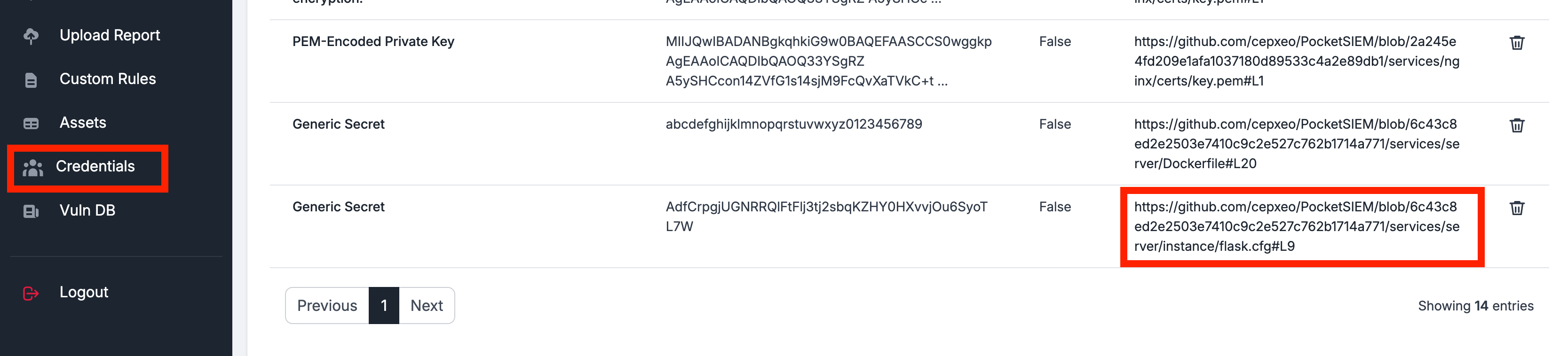
Credentials that match a login/password pattern can then be checked for validity by the Bruteforcer scanner — a confirmed credential is a different conversation from a suspected one.
Secrets results are not exported to DefectDojo by default, given the nature of the data. The Export Secrets Detection to DefectDojo checkbox controls this per scan.
Last reviewed 2026-08-16